
Replying to a question in the Lok Sabha, Jitin Prasada, Minister of State for Petroleum and Natural gas, said natural gas production in India has increased 75 per cent compared to 2008-09 and is expected to double in near future.

Taiwan is keen to collaborate with India and help it become a leader in the semiconductor space, Jason Ho, chairman of the Taiwan Chamber of Commerce in India, said, asserting that the Taiwanese companies have the supply chain for things that the Indian market needs. Manufacturing semiconductors - used in electric and hybrid cars, drones, and communication devices - is fairly complicated, entails huge investment, and can be a cumbersome process.

Equity benchmark indices Sensex and Nifty tumbled in early trade on Monday amid heightened tensions in the Middle East after the US bombed three major nuclear sites in Iran. The 30-share BSE Sensex tumbled 705.65 points to 81,702.52 in early trade. The 50-share NSE Nifty dropped 182.85 points to 24,929.55.

Union Minister Ravi Shankar Prasad on Tuesday said foreign investments and innovations are welcome but at the same time, the government is focussed on promoting Indian innovation as well as keen on the country's safety and security. Speaking at the India Mobile Congress 2020, the IT and Telecom Minister said that IT and communications sectors have registered over 7 per cent growth and received one of the highest Foreign Direct Investment (FDI) even during the challenging time of COVID-19.
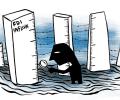
A series of steps taken by the government to promote ease of doing business and liberalisation of foreign direct investment norms have helped India receive record FDI inflows so far this year, and implementation of measures like PM Gati Shakti, single window clearance and GIS-mapped land bank are expected to further push investments in 2022. Notwithstanding the global slowdown and the COVID-19 pandemic, total foreign direct investments into India rose to a record $81.72 billion in 2020-21. During April-July this fiscal, FDI (foreign direct investment) into the country increased by 62 per cent to $27.37 billion.

Countries all over the world are struggling to attract foreign direct investment.

The government has amended rules of the Foreign Exchange Management Act (FEMA), paving the way for up to 20 per cent foreign direct investment in the insurance behemoth LIC. The government is planning to dilute its stake in LIC through the the Initial Public Offering (IPO). LIC in February had filed the Draft Red Herring Prospectus (DRHP) before the markets regulator Sebi for the IPO.

You can remit abroad or in India. Both entail their own risks.

The Securities and Exchange Board of India (Sebi) has deferred the diktat requiring foreign investors to disclose their mobile number, email addresses and income details to depositories, a move believed to be aimed at curbing practices such as round tripping and money laundering. "Based on the representations received from MIIs (market infrastructure institutions), Sebi has decided to extend the deadline for making 6-KYC attributes mandatory for new accounts opened by 1 month to July 1, 2021. "Participants are accordingly requested to take note of the above and ensure compliance," NSDL said in a note on Tuesday. The regulator is also meeting custodians this week to thrash out a solution and address investors' concerns.

To boost domestic manufacturing under the Make in India initiative and reduce dependency on imports, the government is expected to announce in the Budget an increase in the minimum local content requirement for public procurement, with certain sectors being granted exceptions. Currently, firms producing goods, services, or works with at least 50 per cent local content are classified as Class-I local suppliers and are preferred the most in government procurement.

India's craft chocolate makers are changing the market by using local cacao, creating bold new flavours, making chocolate both a luxury and a story.
At present, the FDI limit for FM radio companies is 20 per cent. A senior Trai official has indicated that it could recommend an increase between 26 and 74 per cent.

The India-United States relationship is set to expand under the Donald Trump administration, but there could be some unease on issues like imports, tariffs and immigration, strategic affairs experts said after the Republican leader won the fiercely contested presidential election.

Reliance 4IR Realty Development, a unit of Mukesh Ambani's Reliance Industries, paid a Rs 86.5 crore 'development fee' to license the Trump brand for a forthcoming real estate project in Mumbai.

Singapore continued to be the largest source of FDI in India followed by Mauritius, the US, the Netherlands and Japan.

Domestic institutional investors (DIIs), mostly mutual funds and insurance companies, overtook foreign portfolio investors (FPIs) in ownership of NSE-listed companies in the March quarter of 2025. According to Prime Database, DIIs held a 17.62 per cent stake, up from 16.89 per cent in the December 2024 quarter.
India's telecom sector, billed as one of the fastest growing markets globally this decade, has attracted foreign direct investment worth $1.05 billion in the past two years, the government said in a statement on Monday.

'We may see even more restrictive policies during 2.0.'

China which recently emerged as the world's second largest economy has now become the fifth biggest global investor even as Foreign Direct Investment into the country is set to cross $100 billion this year.

Indian growth in the rest of this fiscal year and next will be propelled by robust domestic consumption as consumer confidence improves, and by investment, including large increases in government capital expenditure, according to the Asian Development Outlook September 2023. "As slowing exports could foment headwinds for the economy, and erratic rainfall patterns are likely to undermine agricultural output, the growth forecast for FY2023 is revised down marginally to 6.3 per cent," ADB said.
Titan, HCL Tech and State Bank of India were also among the laggards. However, Hindustan Unilever, Asian Paints, ICICI Bank, Power Grid, HDFC Bank and ITC were the gainers.

There has been a decent growth in FDI proposals and new announcements in India to attract foreign investment.

A day after lambasting e-commerce players for predatory pricing, Union Commerce Minister Piyush Goyal on Thursday said he is not against online platforms but India wants such entities to be "fair and honest" in their conduct. Speaking with reporters in the financial capital, the outspoken Union minister said the rule of the law should be followed in letter and spirit, and made it clear that consumer preferences should not be influenced by algorithms.
Total foreign direct investment into India rose 2 per cent to the "highest ever" $83.57 billion in 2021-22 on account of various measures like policy reforms and ease of doing business taken by the government, the commerce and industry ministry said on Friday. Total FDI comprises equity inflows, reinvested earnings and other capital. In 2020-21, the inflow stood at $81.97 billion. It was $74.39 billion in 2019-20 and $62 billion in 2018-19. "India has recorded the highest ever annual FDI inflow of $83.57 billion in 2021-22," the ministry noted in a statement.

India on Thursday unleashed a second wave of reforms deciding to open the pension sector to foreign investment and raising the foreign direct investment cap in insurance to 49 per cent, undeterred by opposition to its decisions on FDI in retail and threats to block these legislations.

New Delhi, while opting not to retaliate yet to the American tariffs, has in recent weeks sought to reinforce its friendship with Moscow, and recalibrate its ties with Beijing rather than surrender to Washington's diktats.

Market participants do not expect any immediate impact on the rupee from the Reserve Bank of India's (RBI's) a "comprehensive" master direction aimed at strengthening the framework for hedging foreign exchange risks. RBI Governor Shaktikanta Das, in his monetary policy statement, revealed that the central bank is poised to issue a master direction to consolidate guidelines for all types of forex transactions. But this development, according to market players, is more of a directional guidance than a mandatory directive.

'Indian private universities can provide world-class education at one fourth the cost, home comforts, and direct links to Indian and global industries.'

A multibagger stock multiplies its original investment several times, delivering returns of 100%, 200%, or even higher. The excitement of finding such wealth creators is undeniable, but the process of identifying them is far from simple. It requires a careful blend of research, patience, and the right set of tools.

The two ministers are believed to have discussed the issue of redefining foreign direct investment and foreign institutional investment to remove ambiguities.

India, the world's fifth largest economy in the world, is likely to overtake Japan to become the world's third-largest economy with a GDP of $7.3 trillion by 2030, S&P Global Market Intelligence said in its latest issue of PMI. After two years of rapid economic growth in 2021 and 2022, the Indian economy has continued to show sustained strong growth during the 2023 calendar year. India's gross domestic product (GDP) is expected to grow 6.2-6.3 per cent in the fiscal year ending in March 2024, being the fastest-growing major economy this fiscal year.
In May 2010 the foreign direct investment was $2.21 billion.

Restricting air access to foreign carriers by not granting them more bilateral rights is akin to shooting yourself in the foot, as air transport is a wealth multiplier for India's economy, Emirates President Tim Clark said during a press conference held on the sidelines of the annual general meeting of the International Air Transport Association.
The Group of Ministers on Foreign Direct Investment has recommended that the proposal to allow 100 per cent foreign direct investment in scientific magazines and journals be placed before the Cabinet, Rajya Sabha was informed on Monday.

The Budget should undertake further reductions in import tariffs and seriously consider an announcement of India's intention to join one or both of the two Asian mega-regional free trade agreements, suggests Shankar Acharya, former chief economic adviser to the Government of India.
Sebi aims to stay proactive as HFT and quant firms like Citadel Securities, Optiver, Millennium, and IMC Trading are expanding rapidly in India, which is home to the world's largest derivatives market by contracts traded.

Interrupting a two-month streak of decline, outward foreign direct investment (FDI) rose sequentially to $1.85 billion in July over $1.07 billion in June, an increase of 73 per cent. However, it was lower than the $2.18 billion in July last year, according to the Reserve Bank of India data. Outbound FDI, expressed as financial commitment, has three components - equity, loans, and guarantees.

The main sectors that receive the maximum foreign inflows include services, computer software and hardware, telecommunications, trading, construction, automobile, and power.
The Railway Minister has announced that there is an urgency to attract FDI in Railway projects.
